The Random Access Information Blog has moved to a new URL address. You can find new posts at: raiwebs.com

Tuesday, September 22, 2009

Anime Weekend Atlanta (AWA) 2009: Part 2: I Only Meant to Stay Awhile


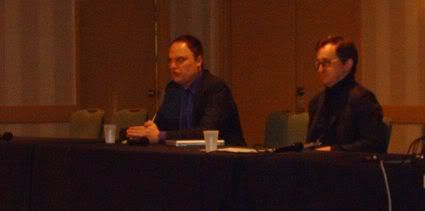
Panel of Doom hosted by Daryl Surat

ATLANTA, September 20 – On the second day of the AWA, I slept in a little. I was tired from the previous day’s travel and didn’t get much rest. I rolled out of my hotel room late in the afternoon to attend Gerald Rathkolb’s (Anime World Order (AWO) host) panel.

He was hosting a panel on AIC in the 80s. Anime International Company (AIC) is an animation studio which produced many beloved OAV titles in the 1980s. Many of the OVA titles made their way to local video rental stores like Blockbuster spawning a new generation of anime fans. Gerald showed trailers from shows like Cybernetics Guardian (聖獣機サイガード), Gall Force 2 - Destruction (ガルフォース2), and Madox-01 (メタルスキンパニック MADOX-01). It was a nostalgic trip through my childhood anime fandom.

At the panel, I unexpectedly bumped into Ed Chavez, Marketing Director for Vertical, Inc. I was completely surprised. I didn’t think he was going to attend this convention. He said that it was a last minute decision. We talked for a bit and made our way to Daryl Surat’s (AWO host and Otaku USA writer) panel. There was some confusion. The time of the panel was pushed back, but there was very little notice in the schedule (except for some fliers in the hallway).

Daryl hosted the Panel of Doom which is a hilarious mash up of anime, live action, commercials, and documentary footage. I’ve seen the Panel of Doom in past anime conventions, and Daryl managed to keep thing fresh by incorporating new videos.
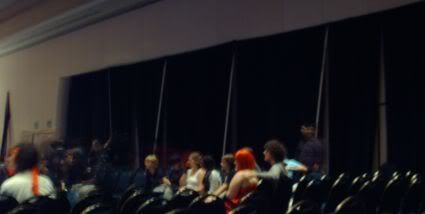

Falling Curtain, Panel of Doom

In the middle of his panel, a large curtain accidentally fell on audience members in the back of the room. It was dangerous because the curtains were attached to large metal poles. Daryl briefly stopped the panel as people were trying to fix the curtain. It was a surreal experience.

After Daryl’s panel, a group of us went to grab a quick bite at the Cumberland Mall’s food court. We rushed back to the convention because Clarissa Graffeo (AWO host and Otaku USA writer) and Gerald had to set-up their Doujin panel.

Gerald and Clarissa’s Doujin panel was an over 18 affair because of all the adult material notoriously associated with doujinshi (同人誌). Doujinshi refers to a wide array of original fan made products related to manga and anime. They covered a lot of material including games, prose fiction, manga, and music.

After the panel, a small group consisting of audience members and panelists talked about doujinshi. The group included: Carl Gustav Horn (Dark Horse Manga Editor), Clarissa, Gerald, Ed, Max, and others. We discussed a variety of topics ranging from Japanese cultural history to the Otaku phenomenon. The group was very nomadic. We moved around to several locations and continued our conversations while walking around the Renaissance Waverly Hotel.

Eventually, we settled down at a table in the atrium. Shortly after Daryl joined us, a security guard walked over to our table and told us that the atrium was closing. Clarissa looked at her watch and remarked that, “its 3:30.” I don’t think anyone realized how long we were talking. I went back to my hotel room and slept.
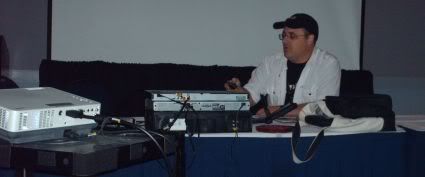

The Anime Treasure Chest Panel hosted by Tim Eldred

The next morning Ed and I went to Tim Eldred’s Anime Treasure Chest panel. He started the panel in grand fashion with the Daicon IV opening film. The Daicon IV film was an amateur piece of animation created by members of Gainax (株式会社ガイナックス) before they became a professional studio. It was seminal film in anime history. Tim also showed some amazing scenes from the revamped Fist of the North Star (北斗の拳) series. It was a chock-full of awesome. The high budget animation was pretty amazing. I need to get copies of it. Towards the end of his panel, he showed an anime UFO documentary. It was quite bizarre. I need to ask Tim more about it.

Then we attended Clarissa’s Black Jack panel. She did a basic introduction to the manga and anime series. I was amazed that her panel was well attended. Usually panels covering older anime and manga properties have smaller audiences because most younger fans don’t follow older work. I was pleasantly surprised at the turn out.

After her panel, Clarissa and I went over to Carl’s Evangelion panel. He started with a quick rundown of future Dark Horse releases. Smoothly he transitioned into the different Evangelion titles being released by Dark Horse. He talked about his theories regarding the Eva story arc and the multiple endings. The crowd seemed excited. There was a pretty active back-and-forth conversation between the host and the audience.

I briefly joined Daryl at Tim’s Star Blazer (宇宙戦艦ヤマト) panel before rushing over to Ed’s Vertical panel.
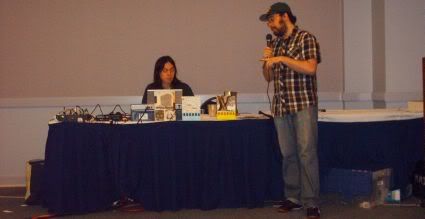

The Vertical Panel hosted by Ed Chavez

During his panel, Ed talked about the variety of releases by Vertical Inc. He mentioned some of the Osamu Tezuka (手塚 治虫) releases such as Black Jack and Dororo (Winner - Will Eisner Award for Best U.S. Edition of International Material). He also promoted Vertical’s non-manga release such as Tetsuya Nishio's Sudoku Plus series, Kentaro Kobayashi's Easy Japanese Cooking series, and Toshio Okada's Sayonara, Mr. Fatty!: A Geek's Diet Memoir.

After his panel, Ed and I ended the convention by attending a viewing of Dave Merrill’s Ozone Commandos. It’s a campy fan produced sci-fi adventure movie. I thought it was pretty wild and filled with tons of geeky references.

Monday, September 21, 2009

Anime Weekend Atlanta (AWA) 2009: Part 1: Anime Hell


State of the Manga Industry Panel with Carl Horn and Jonathan Tarbox

ATLANTA, September 18 – On a gloomy gray Friday afternoon, I attended Anime Weekend Atlanta (AWA) at the Renaissance Waverly Hotel. I started the convention by slowly browsing the dealer’s room looking over the latest anime and manga merchandise. I ran into Gerald Rathkolb, one of the Anime World Order (AWO) podcasting trinity. AWO is one of the most popular anime podcasts according to the recent Parsec Awards. He was accompanied by a dry witted Max as they were buzzing around some anime posters.

After some more dealers’ room reconnaissance, we went to the State of the Manga Industry panel which was being hosted by Carl Gustav Horn, Dark Horse Manga Editor, and Jonathan Tarbox, the former editor of Raijin Comics. They discussed some broad topics concerning the manga industry in America. Some of the more interesting points discussed were the production costs, market development, and the localization efforts. At the panel, we joined up with the remaining AWO trinity at the panel: Daryl Surat and Clarissa Graffeo.


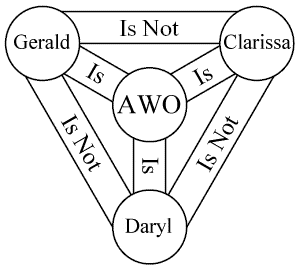
AWO consists of the three persons in the one anime podcasting divinity


After the panel, I took a quick second to check into my hotel room and rejoined the AWO at Dave Merrill’s Western Influence on Anime panel. Merrill showed a variety of anime properties based on western literature such as Lensman, Superbook (アニメ 親子劇場), and Starship Troopers.

I was introduced to the amazing Tim Eldred, the creator of Grease Monkey and the biggest Space Battleship Yamato (a.k.a. Star Blazers) (宇宙戦艦ヤマト) fan ever. He was very cool. His knowledge of Yamato seemed limitless. I was a fan of the show and eagerly listened to his stories about Yamato fandom. He knew all the back stories about the production and the behind the scene details. I was captivated by the raw awesomeness of his Yamato knowledge. Tim runs the official Star Blazers website and does a webcomic of the show.


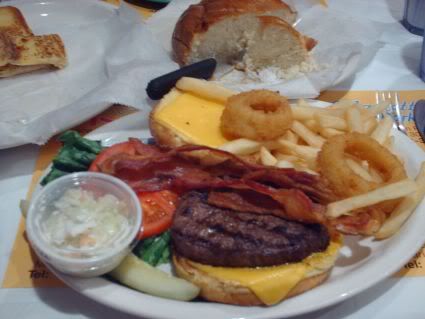
A bunch of us went to Marietta Diner for dinner. Daryl warned us that the portion were huge. I ordered a burger, and I got a huge plate of food. I only had few minutes to eat because Gerald had to get back to the convention. He was doing a panel on the History of Hentai. I ate very little of the burger before we had to rush back to the convention.

Gerald’s hentai (変態) panel was packed. At first he encountered a lot of technical problems with the projector set-up which really cut down on his presentation time. After Gerald got everything working, he went over a brief introduction of early hentai including Ukiyo-e (浮世絵) influences. He had to rush through many sections of his presentation.


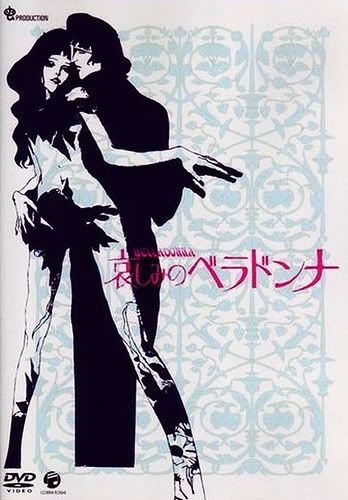
He eventually got to Osama Tezuka’s hentai movies: 1001 Arabian Nights, Cleopatra (クレオパトラ), and Belladonna (哀しみのベラドンナ). This was the bulk of his presentation. I’ve seen stills and read about these movies on the internet, but this was my first time that I’ve actually watched the anime. The films were a bizarre alchemic mixture of bright colors, sex, and music. Being very trippy and experimental, they were quite a departure from Tezuka’s earlier works such as Astro Boy (鉄腕アトム) and Kimba the White Lion (ジャングル大帝). I highly suggest that any hardcore anime otaku must see these films. They are a fascinating look into the darker side of Tezuka’s genius.

Following Gerald’s hentai panel, I went straight to Dave Merrill’s Anime Hell. Daryl sent me a text message earlier stating that “Hell is where the heart is…” Therefore, I had to attend. Dave showed a hilarious mash-up of videos. I am legally prohibited from describing the panel. It’s just one of those things that you have to experience. However, there is one thing I will say… Dave played the opening sequence from Kikaider (人造人間キカイダー) and shouted, “If you know the words, sing-a-long! Switchy… On… 1… 2… 3…” I think only Dave and I were singing.

Thursday, August 6, 2009

Alfa, a Supergirl Rockstar


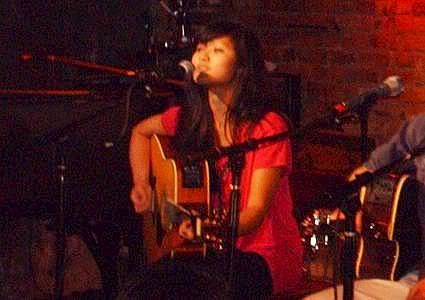
NEW YORK, August 4 – Alfa Garcia joined other singer/songwriters at the Bitter End (147 Bleecker Street) for a mellow evening of unplugged tunes. The event was called the Songwriter's Circle, and its purpose is the promotion of local indie musicians in the vein of James Taylor and Norah Jones. The format of the event was basically a round-robin. Each performer played a song and passed the spot light to the next performer. Alfa managed to perform three songs including “Supergirl" and "Isabelle".

The striped down nature of the event played to Alfa's strengths as a performer and a songwriter. Despite some of her modest comments about her own music, Alfa masterfully performed everything from a sweet candy pop tune to a rustic familial love song. Her engaging musical stylings revealed an honest emotional vulnerability which was very refreshing. In addition, Alfa's vocals are amazingly understated. They gently demand your attention and proceed to slowly envelop your senses. She was pretty awesome.

Alfa recently released her debut independent LP, "Second Skin". It is now available on iTunes and Amazon.

Check alfa-music.com for more information and performance dates. She is playing several dates in New York and a single date at the Kollaboration's Acoustic 3 Concert in Los Angeles.

Related Links:

Sunday, August 2, 2009

All Points West Festival 2009

JERSEY CITY, August 2 – I came for the Echo and the Bunny Men and staid for the Coldplay and MGMT.


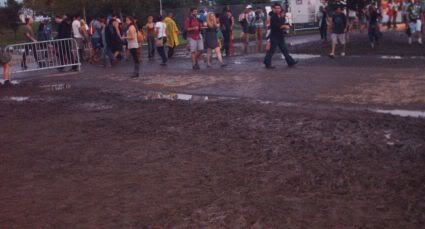
Outdoor Music Festivals = Mud


Echo and The Bunnymen performing "The Killing Moon"


Coldplay performing "Yellow" (with large yellow balloons filled with confetti)

Related Links:

Friday, July 31, 2009

Vertical Vednesday: The Hard Sell for the Light Novel


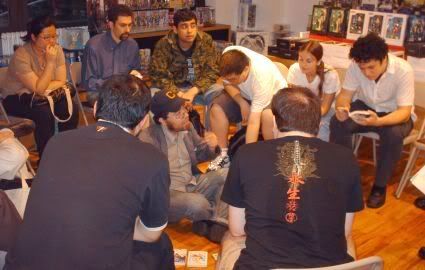
NEW YORK, July 29 – I attended another installment of a discussion series hosted by Ed Chavez, Marketing Director for Vertical, Inc. The event was being held at Kinokuniya (1073 Avenue of the Americas). (See a prior post about the Vertical Vednesdays series.)

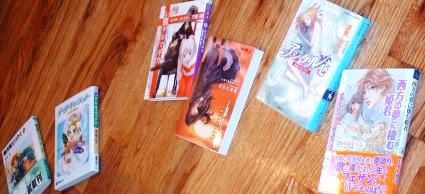
The topic of discussion was the humble Japanese light novel. Light novels are essentially novellas written for the young adult market in Japan. Some of the more successful titles in this genre are The Melancholy of Haruhi Suzumiya (涼宮ハルヒの憂鬱), Vampire Hunter D (吸血鬼ハンターD), and Scrapped Princess (スクラップド・プリンセス).

The group talked about many aspects of the light novel, but the main focus of the discussion was centered on the difficulty of marketing them to an American audiences.

The real problem is the lack of an existing American market for the light novel. Perhaps the only comparative literary market to the light novel in America is the pulp fiction boom between the 1920s until 1950s. The dime store novel. However, since the collapse of the pulp industry, there has never been a resurgence of the pulp format.


In the case of the Japanese light novel, publishers need to build a market from the ground floor. This can prove to be herculean task.

One of the major obstacles is penetrating the American fiction market. The majority of light novels are localized and marketed by manga companies, and many retailers tend to shelve them with manga titles instead of the prose fiction. This can prevent market growth due to the lack of exposure with non-manga readers. Some publishers understand this reality and try to avoid any marketing connections between some light novels and their manga ties.

It will be interesting to follow the development of this market in the next few years.

Related Links: